Providing relief, facilitating connections & building knowledge in the arts
It should come as no surprise that the arts are an essential facet of social development – yet, too often they are overlooked. Together with donor support, ISM facilitates the realisation of an institutional plan for our upcoming, local partner Association for Myanmar Contemporary Arts (AMCA). AMCA serves many valuable but underrepresented contributors to Myanmar society: artists
A fund for artists created in 2021 in response to the double crisis that threatened the livelihoods of artist. It’s objective is to support the continued and sustained creation of art even in unstable times.
An independent, locally led organisation that is implementing the final and most crucial phase of the Artist Fund project.
Through a series of outputs from 2021 to 2023, artists were reached and the arts were focalised
Recognised the arts as a valid sub sector of development by conceiving a project that is informed by its artist- community stakeholders
Awarded grants to over 100 practicing artists across Myanmar in two cycles
Assembled an alumni group from past grant awardees to encourage friendly, independent, self- organising practice in the arts that goes beyond the ARF project.
Local arts Organisation AMCA was identified as a partner to envision and implement innovative grant-giving schemes that gave rise to grant cycles 3 & 4.
After administering cycle 3 of grants and overseeing the cycle-end exhibition, AMCA is looking to develop as an organisation and in the process has provided opportunities to upcoming cultural workers to be mentored and gain exposure to arts organising by creating jobs in the cultural sector. As a result of the success of the partnership, ISM was able to to secure further funding for the Artist Fund which goes towards AMCA’s plans to engage more artists in different ways.
Cycle 4 of grants is underway and with it, AMCA as a the implementing organisation focuses to satisfy the the needs of the arts community with nuance and with sustainability in mind.
Artist residencies are one of the pillars of contemporary art practice which many artists consider to be indispensable to their careers. They provide a way for the artist to incubate with their ideas and their reference material, often with one or several collaborators doing something similar.
In residency artists accomplish what they planned to, or they find greater inspiration that they let lead the process of exploration and production. The process, for artists, is often more valuable than the result. It is in this gradual state that experimentation takes place, evaluation and re-evaluation enriches it, where lessons are learnt and where the artist’s diligence carries the experience to conclusion.
AMCA is the ARF’s new partner, and it plays a pivotal role as the project implementer. Bringing a residency component to grant planning is notably AMCA’s doing. AMCA is artist-run which makes the organisation and its activities particularly well-informed and sensitive to the needs of the stakeholders- artists. These artists are from across the country and from a diversity of disciplines. The third cycle of grants was administered by AMCA in March of this year. There was a clear distinction from when the open call was made between those who would be awarded grants for resilience, and those who needed emergency financial relief.
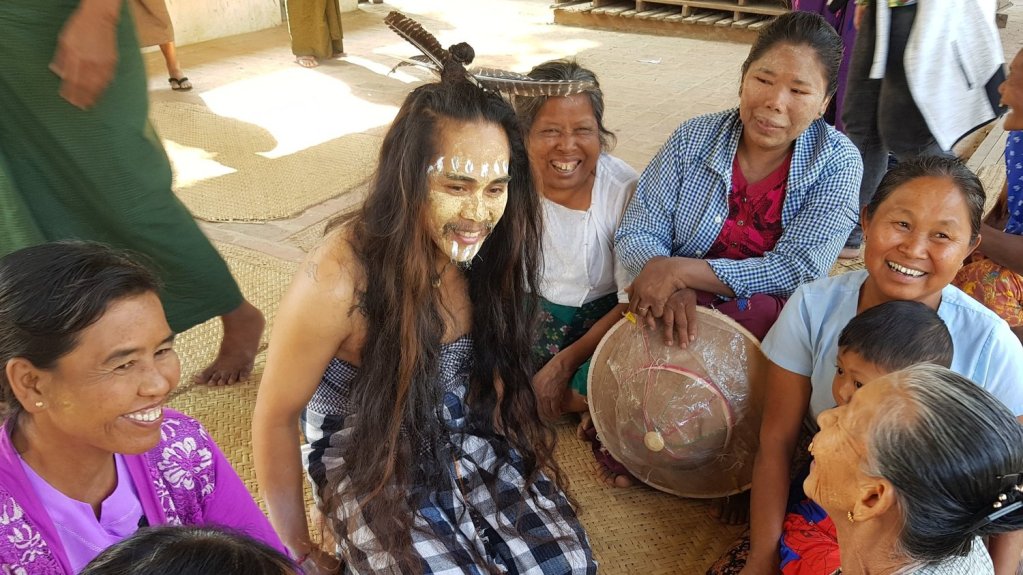
A third category was conceived by AMCA upon reviewing submissions, that presented a new modality for future grantmaking. Four emerging artists caught ISM’s eye with the undeniably social aspect to their arts proposal. They were then chosen to pilot this interdisciplinary programme,the Local Residency Grant, in Pindaya, Southern Shan state. That’s where four grant awardees in groups of two became proximate neighbours over a span of 6 weeks as artists-in-residency. The artists, who are aged 18 to 35, come from varying backgrounds, disciplines and approaches to artmaking but they have at least one thing in common: the desire to involve the community.
The support and engagement of the community of Pindaya and the participation of local cultural practitioners was an imperative part of the residency. The artist groups facilitated exploration of the neighbourhoods after being provided exclusive access to elements such as spaces, events and the local people who make them unique.
An exchange and collaboration with local artists and the community
Educating children and youngsters using a specially-conceived short curriculum about gender diversity
An exploration of local issues geography and cultural diversity through the lens of public art
The simultaneous promotion of small and local, heritage, bio-business
A total of 100 community members of which half were children, participated in the activities created and implemented by the artists-in-residence. Of those activities, some were multi-day workshops. During these workshops, the participants were guided in the important practice of self-expression as well as how to interpret meaning using symbols, colours and context as cues
Art residencies don’t usually just finish without some sort of commemoration of the experience. To conclude the time spent intensively learning, exploring and creating, a final product is presented. The Pindaya community was a great collaborator, lending support through its members along with their local skills. The same community was also a welcoming and receptive audience at the end of the residency.